Opus 5.5 is a fantastic model. It's taken all the best bits from previous Opus models and Fable and turned it into something very special.
We've now reached a tipping point. There is no denying it anymore. The hallucinations are all but gone, the tools at the LLMs disposal are working great and the rate at which LLMs produce code is staggering.
The age of humans hand writing code is over. LLMs are hands down so much better than humans at producing code. It's a new dawn for how we produce software and there is no going back.
The release of Opus 5.5 was spectacularly quiet compared to the usual fanfare that we've had to get used to in the past few years. There was no fear mongering, scare tactics or outlandish benchmark claims. Anthropic just let the model do the talking.
And boy, did it.
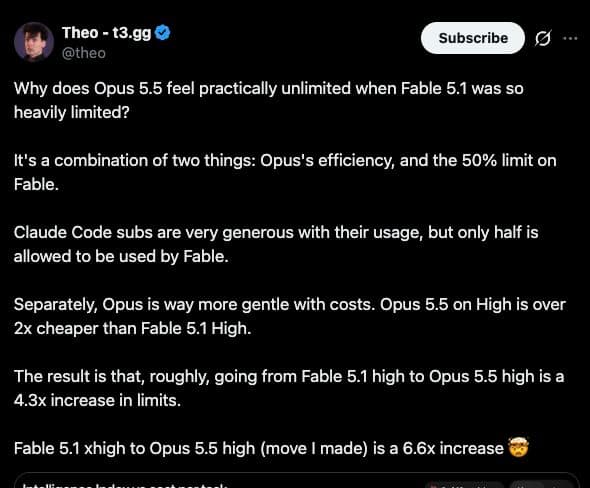
The release page highlights the fact that Opus 5.5 "performs at the level of Claude Fable 5.1" but "costs 40% less to run than Opus 5". This is music to the users' ears. It's almost as if Anthropic listened to its customers.
This is exactly what the community have experienced. The general feedback has been overwhelmingly positive. Wes Bos put it through some tests with 3D modelling - "I can tell you it's def on the fable level". John Lindquist loves it - "Opus 5.5 has re-ignited the joy of agentic dev" and Theo Jaffee writes "My biggest takeaway was that they've really fixed the writing".
It's crazy how quick things can turn around these days. It seemed like just weeks ago that people were already writing Anthropic off as their models were slow and expensive.
What Does This Mean For Software Development With AI?
I personally have been blown away by this new model. Claude Opus 5.5 is simply fantastic. It feels to me like a whole new era of AI.
We've reached the level now with AI where it's indisputable that it's a great tool. If you had shown a developer this 4 years ago they would have thought you'd come 50 years from the future. It's truly incredible
If you're not using AI (and it pains me to say it) you're going to be left behind. I know there are still carpenters making furniture by hand, there are famous designers making clothing by hand but with AI in software it seems different. LLMs are just so damn good at interacting with computers.
Have you ever watched an LLM interact with the computer? The commands it can run in a blink of an eye are humbling. These are massively long commands that are impossible to memorise and take ages to type out.
This is just one example from one thread with Opus 5.5. It runs hundreds of these commands just in one sitting. This would take so long to type out manually.
Watching LLMs at work have made me realise the futility of my feeble attempts before when working in the terminal.
awk, sed, z, jq, docker were commands I used daily - but LLMs take it to a whole new level. One thing that I've had to admit to myself too - the majority of hand written code was very average. I've seen so many issues in code that was hand-written. At work I am finding edge cases galore and a total lack of test coverage on code bases that were previously hand written. This isn't a judgement on the developers that wrote this code, but you realise just how difficult a task we had before.
It seems to me that the average developer didn't actually produce that great code by hand. There are exceptions of course but the problem is these are the exceptions. We keep talking about AI slop code but what about all the hand written slop code?
The Near Term Future With LLMs
So what does this mean going forward? The Opus 5.5 release is a "line in the sand" type moment. It brings little incremental improvements that added together make a huge difference. It doesn't talk as much, it's faster, and it's cheaper. It's beautifully optimised, and I think that's the stage we're at now with models.
We also have new models like Jev coming, which bring a kind of different approach to certain aspects of using LLMs. In terms of large language models, the models themselves aren't probably going to get that much better. I don't see how they can get much better to be honest.
So where's the development going to happen going forward? I think it will be a combination of optimisation and DevX finally settling after years of chaos.
Devs are going to get more and more used to working with LLMs. Workflows are going to iterate and settle. There are so many different approaches at the moment. Software factories, specific agents doing specialised tasks, running agents in the cloud vs on your machine. There doesn't seem to be a defined best practice yet. We're still working stuff out. Just this week I discovered a new approach to working with agents from Poteto which again changes my workflow.
The Future Of Tooling
It's much easier to produce tools. It's still not easy to produce good tools, but it's easy to produce useful tools. Lots of little tools people are already making themselves. The market for tools that are the size of Raycast etc are all but gone. In this case an AI slop fork was made - Tinycast - which is essentially a copy of Raycast but for free. It still takes a little bit of time to build your own personalised tools but once you have you have the perfect tool just for you. We are only going to see more of this.
To build a truly fantastic app though still takes time. One main reason is you don't know what you completely want at the beginning of the project. For example, a video editing tool: you can make one now, and plenty of people are with LLMs, but it's not easy to make a really good editor. You need to know about videos, and you need to know the ins and outs of editing and there are many details involved. It's not something that anyone with access to an LLM could make.
The Rise Of The Indie Developer
This one I am very curious about. More and more developers are working alone because they can do more and more by themselves. If you have a good LLM in your corner you can achieve a whole bunch.
Is this a good thing? Like anything in life - it depends. Personally, I would be very happy if I could make $50,000 - $100,000 a year creating small high quality software. If I could do that as an indie developer, I would quit my job and just focus on that 100%. I'm not there yet but it doesn't seem insurmountable in terms of a target.
However, being able to go from an idea to very good software now is easier than ever. This makes it harder than ever to sell software. So I'm still not sure if this indie developer prediction will pan out. I think I'm just secretly hoping it will.
Conclusion
I think the future looks really bright in terms of producing software with LLMs IF (and it's a big if) you're willing to embrace the technology. Opus 5.5 has shown me that you can no longer deny this technology.
I have been a skeptic of LLMs but Opus 5.5 is the model that has finally convinced me the future is with LLMs. I'm now doubting if I will ever write a line of code again. This brings up some strong emotions but it's the reality we're in right now.
We have the opportunity going forward to be able to make really quality software. I think the models now are at such a point where you have no excuses not to make amazing software. I think you shouldn't feel any pressure to make loads of software but high quality is the expectation. If you spend 6 months with AI making one really quality piece of software, I think it's going to be so much more worth it than just banging out a bunch of half-done applications.
Quality is going to shine through more and more, and we've seen this in other industries like the music industry. In that industry, it's quality that stands out amongst the rest nowadays. When it's so easy to make something, quality is the differentiator.